Saturday, May 21, 2011

Swamped


Last fall I consulted with an English couple who had recently relocated from Dubai to Scituate Massachusetts. Although Scituate is a coastal town, their home was not located on the waterfront. The previous owner, however, had excavated a large pond in a naturally wet area at the back edge of their sizable property. Dramatically sited against a rock out cropping, at one time a waterfall had tumbled down the face of the ledge into the first of a pair of connected pools.

    
When I arrived at the site, however, the waterfall was no longer working and the pond was surrounded by nothing but lawn, brambles, and a tangle of weedy vegetation. My clients were eager to restore the waterfall


 and I suggested that we frame the pond with a broad expanse of moisture loving ornamentals.
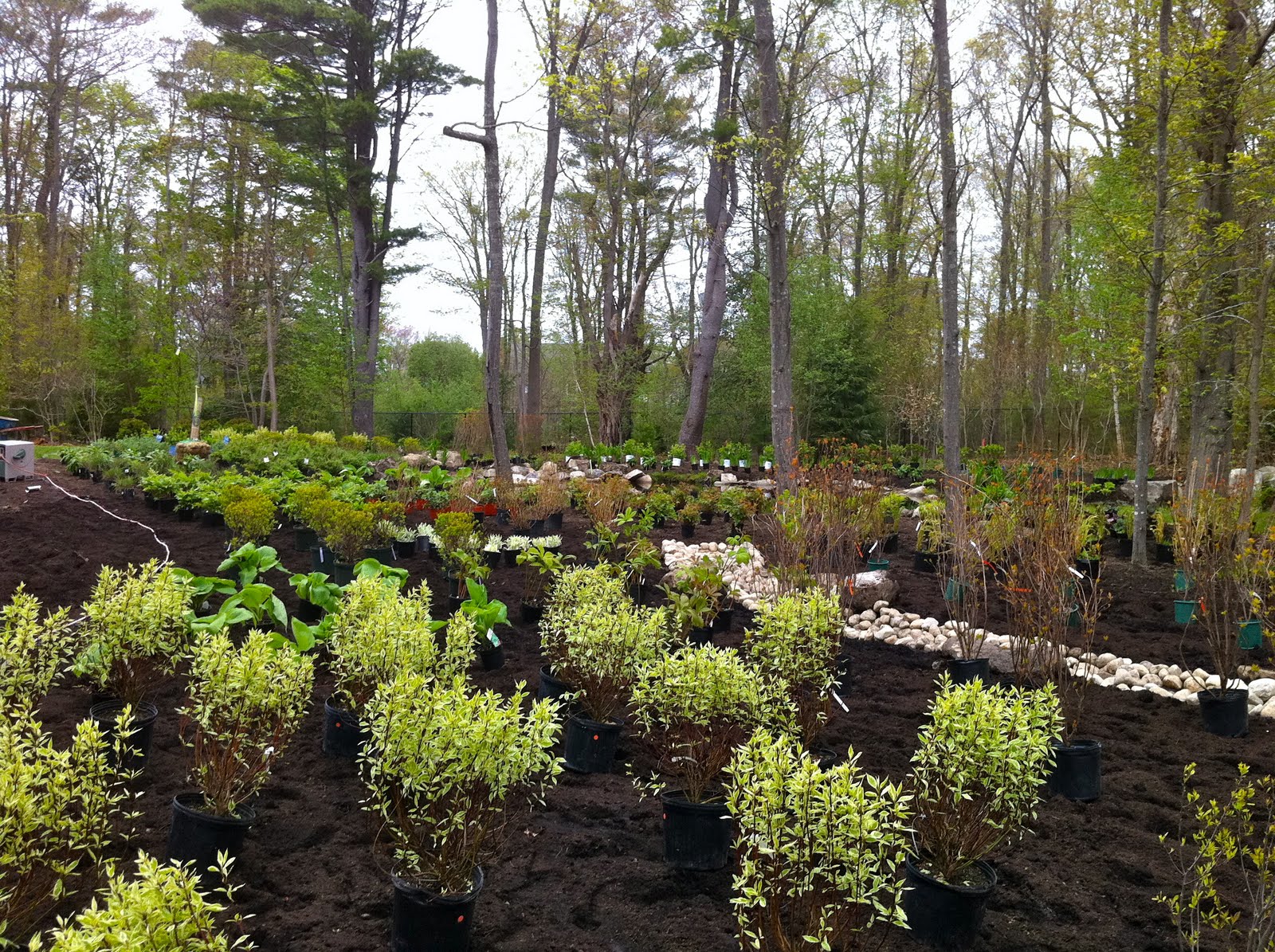


By their very nature projects like this often require an element of improvisation. When we broke ground this spring the area that I had mapped out for the garden was much wetter than I had expected, making excavation and soil preparation quite difficult. Luckily I had hired Mike Downing of Downing Northeast , a talented can-do contractor with whom I had worked on a number of other occasions. We decided to install a visually appealing rock-lined stream bed to concentrate the water in what had once been a natural run off.


Much of the existing soil was heavy clay, whIch I amended with more than sixty yards of compost. Clay is nutrient rich, but difficult for most roots to penetrate. Adding large quantities of organic matter helped to break up the clay thereby creating a better growing medium. In the process of preparing the beds we moved a number of large boulders and reset them along the water's edge, further integrating the pond with the rock outcropping. In keeping with the naturalistic feel of the site I planted the new beds with large groups of  moisture loving shrubs including Summersweet (Clethra Alnifolia), Swamp Azalea (Azalea Viscosum), American Winterberry (Ilex Verticillata), Cornus Ivory Halo (a dwarf variegated red-twig dogwood) and High Bush Cranberry (Viburnum Trilobum). I also included broad sweeps of ferns, hostas, astilbes, Japanese irises and other perennials. In the drier areas I installed masses of hydrangeas and potentillas. It may take a few years, but I'm confident that the new plantings will create a lush frame for the pond, much like farm pond at my house albeit at a much larger scale.


   Meanwhile, here in Seekonk the vanilla scented Clematis Montana Rubens that I'm training over the roof is in full bloom

 
and the white azaleas are in putting on quite a show.
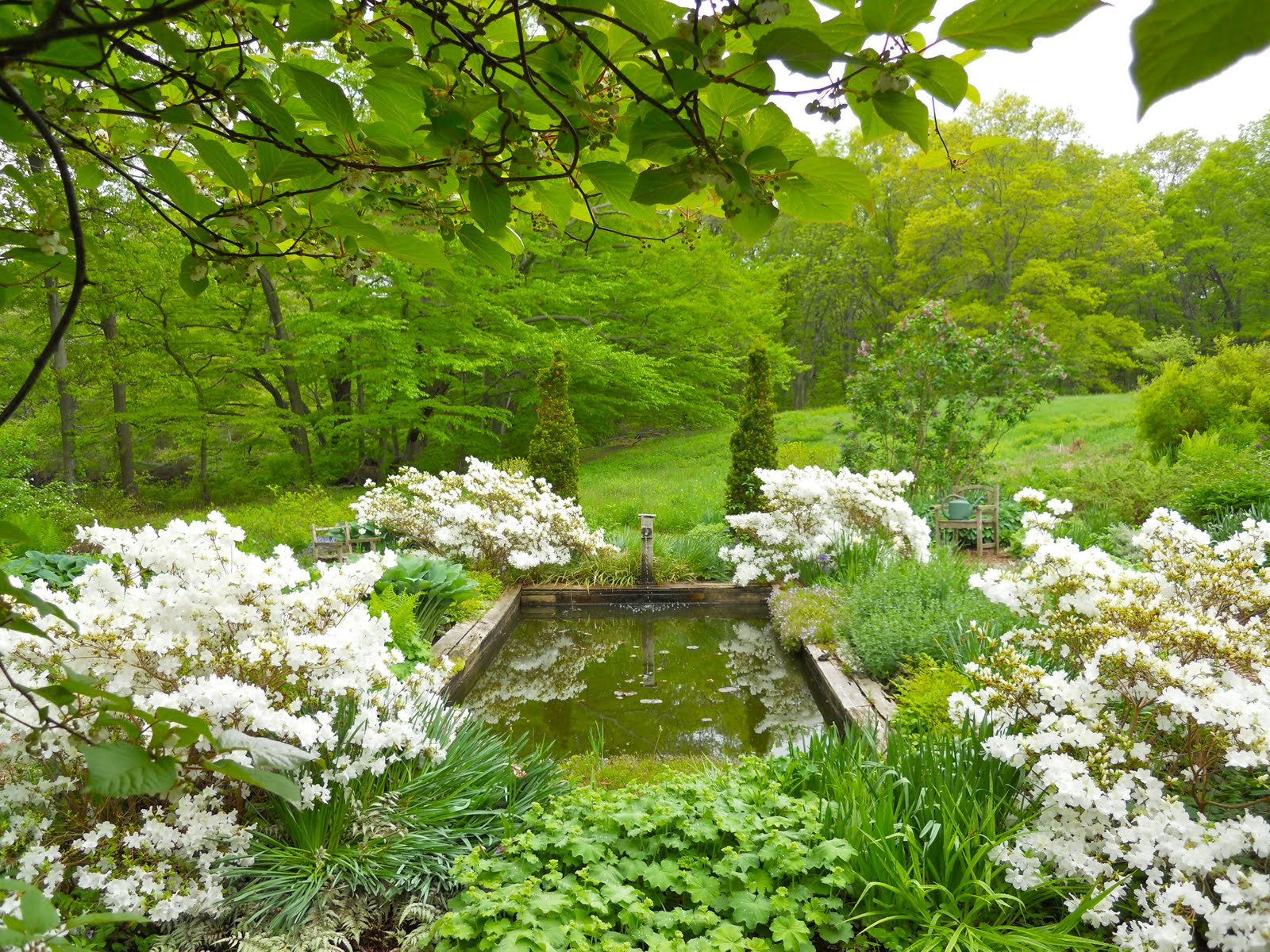


Ahhh Spring :-)

Monday, April 25, 2011

A Bit Daffy


With April's eponymous showers providing consistent moisture the gardens here in Seekonk seem to be growing overnight. It's been a particularly banner year for daffodils and the cool temperatures and gentle rain have kept the abundant blossoms from fading. For the past decade I've planted hundreds of new bulbs each fall and this year the resulting display has been exuberant to say the least.


In the front garden I've concentrated on primarily pink-cupped narcissus. Years ago the variety, Salome, was the premier cultivar in this new trend. Its flowers,however, were actually a yellowish-apricot. But more recent selections like Accent, which I planted in the bed bordering the lawn, produce flowers with trumpets that are more truly pink.


In the Hot Colored garden I've selected predominantly yellow and orange cultivars.


And of course in the Blue and White garden I've chosen exclusively white varieties.


That color scheme, however, has been compromised by a miss-labeled shipment of bulbs that I planted a few years ago. Uncharacteristically I haven't had the heart to rip them out yet.


Further muddying my palette are clusters of an old fashioned double yellow variety that randomly appear without regard for my strict artistic sensibilities. Most these end up in vases in my house.


In fact for the past month I've been cutting armloads of daffodils without putting much of dent in the outdoor display.


On rainy  days It's a real luxury to have flowers from the garden on my kitchen table. It's a luxury, which I like to share. I gave the arrangement pictured below to a friend as a housewarming gift.


The only drawback to planting so many daffodils is the resulting mass of strap-like foliage, which must be allowed to ripen. Unfortunately, to ensure that the bulbs will flower next spring the leaves cannot be removed until they have turned brown. While I try to mask the dying vegetation with perennials, a brief but unsightly phase is almost unavoidable.


But then I guess every rose has its thorns.

Wednesday, March 23, 2011

Let The Games Begin.


The leaves are raked, the roses pruned and the beds freshly edged. The first blossoms of my crocuses are already summoning bees from their hives and the garden seems full of promise. Despite the the landscape's muted palette, the tans and browns possess a contemplative charm that is not without beauty. The lack of vegetation draws the eye to the emerging shoots and the diminutive spring flowers that herald the start of the season.


Emerging from the frozen earth the snowdrops


and the sight of the first hellebore blossoms are in some ways more exciting than June's prolific abundance.


It is at this time of year that the curves and angles of the landscape are most readily observed. Proportions, whether of beds, lawn or structures, impact a design's success and I am reminded that the new arches, which I installed last fall, are too tall and must be lowered before the growing season begins in earnest.


For the past several months the Northeast has been buried beneath record snowfalls. And while the branches of some woody ornamentals succumbed to its weight,the winter-long covering insulated my dormant perennials from frigid temperatures and bitter winds. While cleaning the beds I was relived to find that most everything seems to have weathered the cold. The only notable but unsurprising exception were the tea roses that I purchased from a box store last year. In expectation of their demise I ordered more from Edmund's roses in January and it seems that my cat, Briar, is impatiently awaiting their arrival.


With all my early chores completed ahead of schedule and the gardens looking neat and orderly I am ready for the games to begin. After all what is spring if not the most optimistic of seasons.

Thursday, February 3, 2011

Open for Business


Last fall I sent a few pictures of my property to the Garden Conservancy. The Conservancy is a national organization dedicated to the preservation and restoration of important gardens across the country. As with all non-profits they rely primarily on the generosity of individual donors. They also raise money through their lecture series and the Open Days program, which gives the general public a chance to tour private gardens of note. To date more than 2,500 properties throughout the country have been presented and I was thrilled to be selected for their 2011 season. I was even more flattered to find that they had chosen a picture of my garden for the cover of the Open Days Directory. The directory lists the gardens that can be viewed by visitors this year along with dates, descriptions and directions. If you enjoy visiting gorgeous gardens as much as I do, you might want to order a copy, www.gardenconservancy.org. Of course, if you happen to be in my neighborhood, I hope to see you here on June 18th.


As my pal, Puck, can attest, this winter has turned into quite a snow-fest. I haven't glimpsed even a patch of bare ground for weeks now and more of the white stuff is on the way. While a thick blanket of snow provides wonderful insulation for dormant plants,the sheer quantities of icy precipitation have damaged many of my woody ornamentals. Though I regularly shake the snowflakes from their needles, the columnar yews are no longer standing straight and tall and will require some intensive staking. Snapping under the weight of the last deluge, most of my butterfly bushes have been reduced to a tangle of broken branches. Hopefully they'll sprout from the roots in the spring once I give them a good pruning. Saddened by winter's ravages, I have turned to my garden catalogues for solace.


This week, in an effort to lift my spirits,I placed an order with Edmunds' Roses, edmundsroses.com. I haven't used their catalogue before but I found its descriptions to be informative with regard to both the pros and the cons of their various offerings. Edmunds' is based in Wisconsin, which bodes well for the hardiness of their stock, and I'm hopeful that I'll be pleased by its quality. In addition to a number of tempting hybrid teas, I ordered four Eden roses,a beautiful climber pictured above. I credit my friend, Baruch Kirschenbaum, for bringing this wonderful bush to my attention. A number of years ago he gave one to my mother and I've coveted it ever since. This spring I'll plant the teas in my rose and dahlia cutting garden and the Edens on the archway that marks it's entrance.


I also ordered the Dahlia, Otto's Thrill, as well as two different gladiolus from Dutch Gardens, DutchGardens.com . Despite their reputation for being rigid and funereal, I like gladiolus in the garden. As with tulips and daffodils, I always plant single varieties in groups of eight or more. Clustering the bulbs helps counteract the plant's innate stiffness. I think the one pictured below will be particularly striking in my hot colored garden.


And this pink variety should be lovely in the front cottage garden, where I'll use it in the summer to fill a hole left by a species of late-flowering narcissus.


I can hardly wait for spring!

Wednesday, December 29, 2010

Happy New Year


As the new year approaches the gardens here in Seekonk are nestled under a blanket of snow. Just days before the "Blizzard of 2010" my fence contractor installed the three wooden arches that now mark the entrances to the front garden pictured above. The ensuing snow fall has brought all outdoor labor to a standstill. In truth after spending much of November and early December planting bulbs and preparing the beds for winter, I welcome this well deserved respite from garden chores. Things left undone will simply have to wait for a thaw. In a month or so I'm sure I'll find myself impatiently awaiting the first signs of spring. For now, however, I'm content to enjoy the pristine white landscape from the comfort of my couch. Garden catalogues began arriving before christmas and their glossy photographs have already begun to fuel endless fantasies. Fantasies that don't include April temperatures in the 90's, July hail storms, snails or those slimy lily beetle grubs that made mincemeat of my asiatic lilies last year. Perhaps this summer my new arches will provide the perfect support for the large-flowered clematis that I've always coveted,but have yet to grow successfully. Of course if all of my schemes unfolded according to plan, I might come to miss the challenges and inevitable disappointments that are the gardener's lot in life... or perhaps I'd finally achieve that much touted inner peace that thus far has eluded me.

In any case, I wanted to thank you all for your support and encouragement and for taking the time to read my blog. Here's wishing you a wonderful new year filled with beautiful gardens.

May all your fantasies grow into reality.

Andrew

Monday, November 8, 2010

Getting Along Swimmingly


At about this time last November a client, for whom I've worked for a number of years, approached me about designing a swimming pool for her home in Wilton CT. Of course I jumped at the chance even though the site posed two challenging problems. The first concerned her property's steep grade and the second, which proved to be an even more daunting issue, involved an adjacent reservoir.


The proximity to a wetland area combined with the precipitous slope leading up from the water negated the usual setback regulations. In other words the Wilton Wetland Commission essentially controlled the entire property. I won't regale with the sordid details of the permit process. Suffice it to say that I would have liked to give a piece of my mind to the members of that commission, but sometimes it just isn't possible to speak truth to power. The cost of acquiring the town's approval amounted to little more than highway robbery and their requirements were for the most part ludicrously unnecessary. Nevertheless, my client was committed to the project and we persevered. Although after months of work we still haven't completed the construction, the overall design is taking shape nicely.


In order to mitigate the grading issue, I decided to divide the slope into four separate patio spaces joined by wide flights of stairs. At the very bottom of the pool garden a four foot high wall eliminates the need for a fence, leaving the view of the reservoir unobstructed.


On the second patio level I installed a spa, which is quite close to the house and can be used year around even after the pool has winterized.


We had always intended to construct the cabana, which sits at one end of the pool and has a lovely view of the house and surrounding property.


The fireplace at the opposite end of the pool,however, was a later inspiration that both nicely balances the cabana and provides a spot for gathering on cool nights.


Last month I worked with a very talented backhoe operator for a few days. Together we set the forty large boulders that retain the slopes between the separate patios. The adjoining garden areas are planted with broad sweeps of low, flowering shrubs and perennials that won't obstruct the view.


Although the landscaping may not look like much now, I'm confident that in the years to come the plantings, which are arranged in a palette of blue, white and pink, will both soften and compliment the patios and pool.


As far as the rest of the construction is concerned, we still have to install the fence, the stair rails and the lighting as well as finish both the exterior and interior of the cabana. Given last night's unexpected snowfall, I have a feeling that we'll still be working on this project next spring. I have, however, promised my client that we'll be ready for a Memorial Day party come the end of May. If by chance you were wondering about the small dog that makes an appearance in many of my pictures, his name is Puck and he's my one year old miniature Labradoodle. He's something of a mischievous fellow so I guess his name suites him perfectly.

Sunday, September 26, 2010

Stella.....!!!!!!!!


A year or so after installing the cottage garden in the front of my house I decided that it would be nice to edge the walkways with a low-growing border of some sort. I contemplated dwarf boxwood but thought the effect would be too formal. I also considered lavender, but it does not winter over reliably for me. As it happened a client of mine in Darien, CT was in the process of selling her house and asked if I would like to give some of the perennials in her garden a new home. Some years earlier,as a backdrop to her swimming pool, I had installed a red and yellow garden in which I had included a few groupings of Stella d'oro daylilies. Back then Stella's hadn't achieved quite the level of ubiquity that they currently enjoy. Since that time they have become a mainstay of mall parking lots and other commercial enterprises. Their popularity is understandable. Like most daylilies they are tough and easy to grow. They offer a tremendous flush of bloom in June and then continue to flower more modestly until frost. Their foliage is low and grassy and their small albeit brassy yellow flowers command attention even from a distance. It occurred to me that my client's Stella's would make a cheap ( i.e. free) edging plant for my cottage garden and so I separated her clumps into approximately fifty divisions and planted them along my walkways.


I soon regretted my decision. In spring and late summer the mounds of arching green leaves sprinkled with blossoms were pleasant enough. When the plants burst into full bloom in June, however, the sheer number of flowers overwhelmed the garden and in truth their color was a bit jarring for my taste. The majority of the plants in my garden are not exotic or uncommon. For the most part I select cultivars because of their compositional attributes rather then their pedigree so I don't consider myself to be a plant snob. Even so, each time I'd observe Stella's growing in front of gas stations and shopping plazas I found that I liked them less in my own garden. In fact for years I've been rather embarrassed by their display and in June I'd resolve to rip them out in the fall. Yet once September rolled around and the plants acquired a more sedate charm I'd inevitably change my mind. After all digging out and replacing fifty large daylily clumps is a labor intensive task that requires an outlay of cash.


This past August, however, I received a copy of the Oakes Daylily catalogue. Its pages are filled with tempting photos and the inside front cover promises extra-large divisions. Many of you may remember that I'm not a fan of ordering plants through the mail, having been disappointed time and again by the tiny weaklings that arrived on my doorstep. After repeatedly leafing through the Oakes' catalogue I found that I couldn't resist the variety pictured above, Siloam Bye Lo, which Oakes and the internet list as a diminutive repeat bloomer, and so I ordered fourteen to replace the Stella's along the shorter arms of my walkway. To my pleasant surprise the divisions I received were indeed quite generous and as a bonus the company sent me three additional plants for free. I was so impressed that I've decided to bite the bullet and order thirty-five more this week. It will be such a relief to be rid of the Stella's once and for all and greatful friends have been more than happy to take them off my hands.


As for the rest of my property in Seekonk, despite the fears I expressed in an earlier post, the front garden at least is holding its own. My asters are blooming as are dahlias, roses, phlox, coreopsis, anemones, and salvias. In the early morning and late afternoon light it still looks quite lovely.


The Hot Colored garden is a bit of tangle, though it still has some color and a certain blowzy appeal.


Sadly, the Blue & White garden suffered during this long hot summer. The leaves of the ostrich ferns were completely brown a month ago and I've already cut them to the ground. The hostas are looking tired and there are relatively few plants in bloom. Still from certain angles it's possible to get a feel for its former charm.