Saturday, July 30, 2011
POOL PARTY
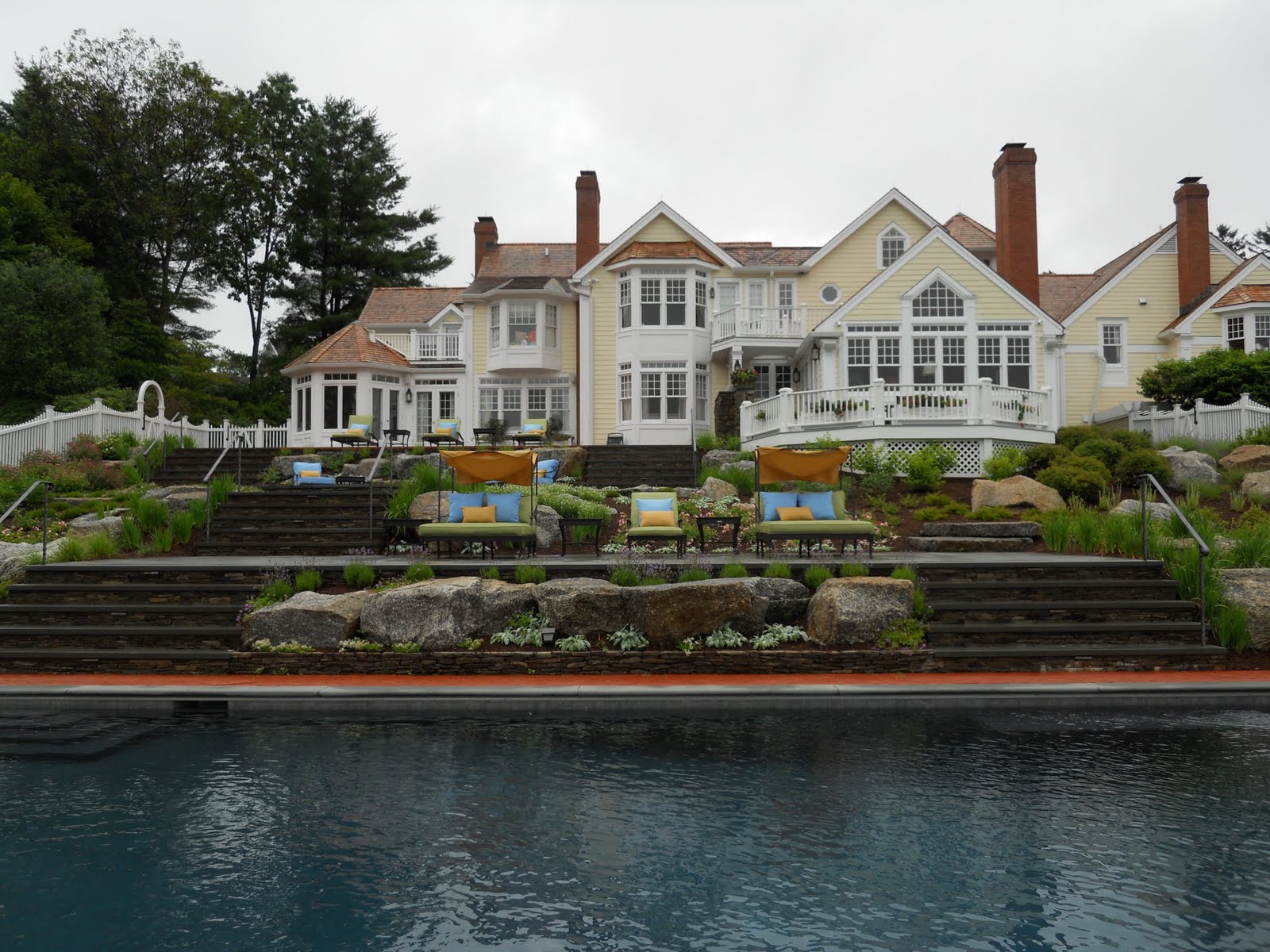
Some of you may recall that more than a year ago I embarked on an extensive swimming pool project for a client in Wilton, CT. The house, which overlooks a reservoir,was built on a steep slope.
Accommodating the pool, spa, cabana, fireplace and patios required moving the existing leach field and terracing the hill. By placing a four foot high stone wall below the swimming pool patio I sidestepped the town's fence requirements and preserved an unobstructed view of the reservoir.
To minimize the need for additional walls I set large boulders into the slope to create a rockery.
The garden is planted with broad swaths of roses, nepeta, grasses, hydrangeas and other low maintenance summer blooming shrubs and perennials. In a few years the plantings will soften the hardscaping and create a lush, billowy effect.
The spa, which can be used year around, was purposely sited below the upper patio close to the house for easy access during the winter.
Although the installation of my design was delayed by town bureaucracy and red tape, construction was finally completed in June. To celebrate my client hosted a wonderful pool party at the beginning of July.
On the home front the gardens here in Seekonk are settling into the dog days of summer. Phlox, oriental lilies and hydrangeas predominate and the rose of sharons are in full bloom.
I've been spending a good deal of time dead-heading and weeding.
The Japanese beetles appeared right on schedule but haven't been terribly destructive so far.
I'm still waging a losing battle against snails. But after a conversation with a friend, whose garden had been mowed to the ground by rabbits, I decided to count my blessings.
After all, snails are easy to catch. And while It's true that their constant feeding disfigures leaves and flowers, it rarely results in mortality.
I'm thrilled with the mottled leafed Colocasia Mojito that I planted by the pond to replace the ornamental rhubarb that mysteriously died. Colocasia's enormous tropical leaves are quite dramatic and plan to dig up the tubers in the fall. Hopefully they'll winter over along with my dahlias in the crawl space below my office.
Although I'm fond of Campsis Radicans' orange and yellow trumpets, I'm growing tired of pulling up the countless seedlings that sprout all over the garden. Still, the hummingbirds would never forgive me if I tore the vines out.
With the onset of summer weather the hot colored garden is really heating up.
Meanwhile the Blue and White garden is cooling down.
I've decided that dusk is my favorite time to view the garden. The shadows mask
the imperfections; the brown leaves, the spent flowers, the crab grass, the stems that need staking, the bare spots that need filling. When the sun has set it's easier to enjoy the big picture and the sweet fragrances that perfume the air.
Wednesday, June 22, 2011
Tour de Force
On Saturday June 18th I opened my garden in Seekonk to the public. The tour was part of the Garden Conservancy's Open Days Program. GC's Open Days take place rain or shine and I had been checking the forecast somewhat obsessively for at least a week prior to the big event. Showers drenched the garden on friday, but luckily I had mowed the lawn and finished the majority of my last minute preparations on thursday. On friday night, however, I lay in bed listening to a torrential rainstorm and wondered if my weeks of anticipation had all been for naught.
I awoke at the crack of dawn to a gray sky. Although some of my more fragile roses had shed their petals overnight,the garden didn't seem much worse for wear. By nine o'clock the haze had cleared and the remainder of the day proved to be sunny and warm,perfect weather for a garden tour.
Pruners in hand I spent the early morning hours trimming spent blossoms and marred leaves. As I worked I eyed all of the flowers that had yet to open and couldn't help wishing that the tour had been scheduled for the following week.
Shrugging off a nagging sense of regret, I reminded myself that the success of a garden depends primarily on its "bones". The flowers are merely the icing on the cake. And while an abundance of blossoms may distract the viewer from errors in structure or proportion, petals alone will not a beautiful garden make.
The first guests arrived just before the official ten o'clock opening and over the course of the day I greeted more than one hundred and thirty people. Without exception all of the visitors were gracious and enthusiastic. And to my surprise, by late afternoon not a single stem had been trampled.
I noted with some amusement that a few of my guests were as captivated by my chickens as they were by the gardens. I acquired the birds at the Swansea Farm Auction, a somewhat anachronistic event that takes place each week in the neighboring town. I had hoped that the chickens would feast on the plague-like multitude of snails that continue to ravage my plants and with great determination I outbid my competitors for my little flock. Not surprisingly my choices were a function of aesthetics. Alas, as with many pretty things, my chickens haven't proved to be very functional. They don't lay many eggs or eat many snails, but they are fun to watch.
Spending the day in the sun greeting guests and answering questions was more tiring than I had expected. Nevertheless when the last of the late arrivals departed at six o'clock, I mentioned to a friend that the weeks of preparation had been well worth the effort. When she asked me what I planned to do the next day I replied in all seriousness "Well, I won't be working in the garden, that's for sure!"
Saturday, May 21, 2011
Swamped
Last fall I consulted with an English couple who had recently relocated from Dubai to Scituate Massachusetts. Although Scituate is a coastal town, their home was not located on the waterfront. The previous owner, however, had excavated a large pond in a naturally wet area at the back edge of their sizable property. Dramatically sited against a rock out cropping, at one time a waterfall had tumbled down the face of the ledge into the first of a pair of connected pools.
When I arrived at the site, however, the waterfall was no longer working and the pond was surrounded by nothing but lawn, brambles, and a tangle of weedy vegetation. My clients were eager to restore the waterfall
and I suggested that we frame the pond with a broad expanse of moisture loving ornamentals.
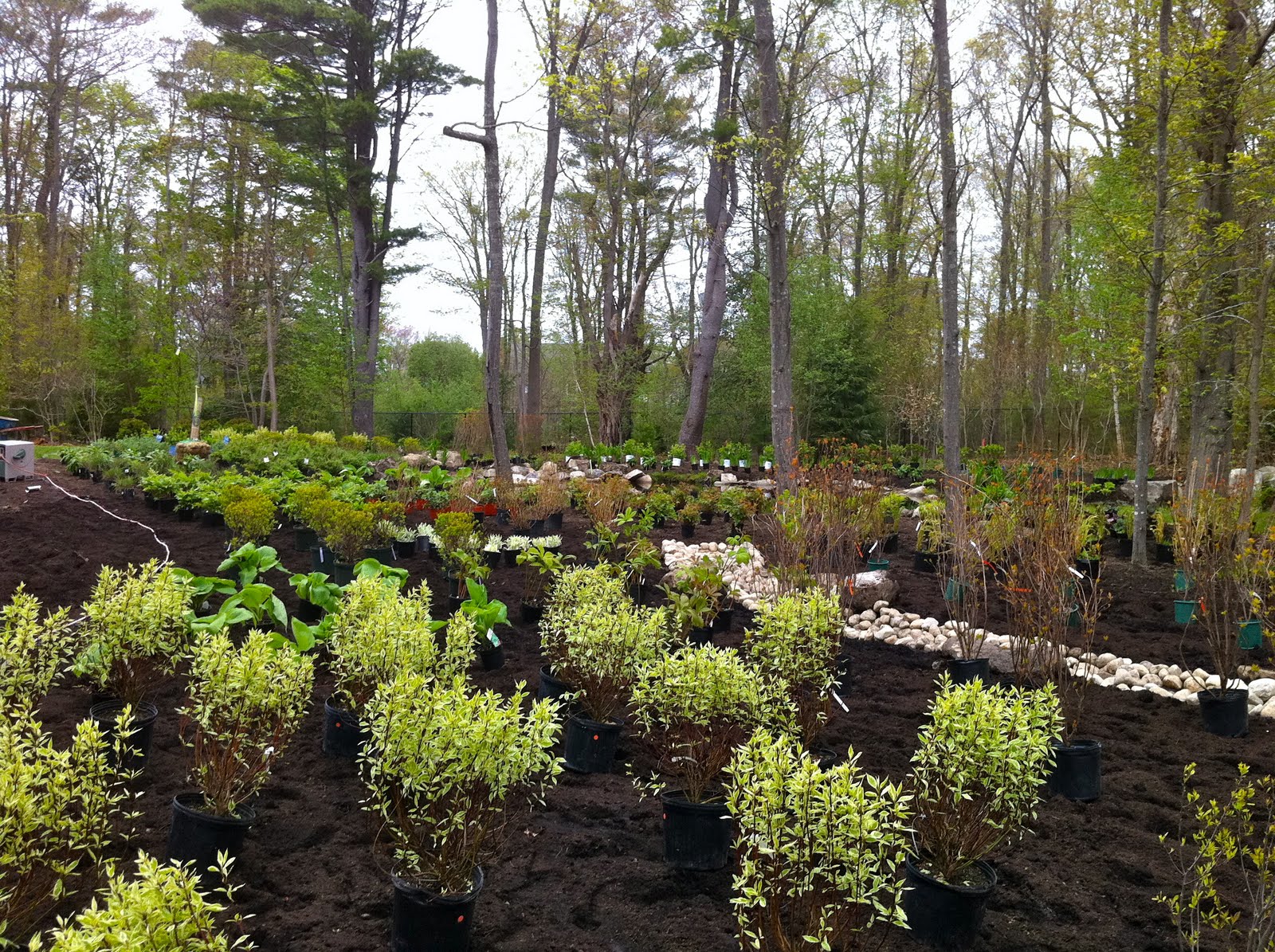
By their very nature projects like this often require an element of improvisation. When we broke ground this spring the area that I had mapped out for the garden was much wetter than I had expected, making excavation and soil preparation quite difficult. Luckily I had hired Mike Downing of Downing Northeast , a talented can-do contractor with whom I had worked on a number of other occasions. We decided to install a visually appealing rock-lined stream bed to concentrate the water in what had once been a natural run off.
Much of the existing soil was heavy clay, whIch I amended with more than sixty yards of compost. Clay is nutrient rich, but difficult for most roots to penetrate. Adding large quantities of organic matter helped to break up the clay thereby creating a better growing medium. In the process of preparing the beds we moved a number of large boulders and reset them along the water's edge, further integrating the pond with the rock outcropping. In keeping with the naturalistic feel of the site I planted the new beds with large groups of moisture loving shrubs including Summersweet (Clethra Alnifolia), Swamp Azalea (Azalea Viscosum), American Winterberry (Ilex Verticillata), Cornus Ivory Halo (a dwarf variegated red-twig dogwood) and High Bush Cranberry (Viburnum Trilobum). I also included broad sweeps of ferns, hostas, astilbes, Japanese irises and other perennials. In the drier areas I installed masses of hydrangeas and potentillas. It may take a few years, but I'm confident that the new plantings will create a lush frame for the pond, much like farm pond at my house albeit at a much larger scale.
Meanwhile, here in Seekonk the vanilla scented Clematis Montana Rubens that I'm training over the roof is in full bloom
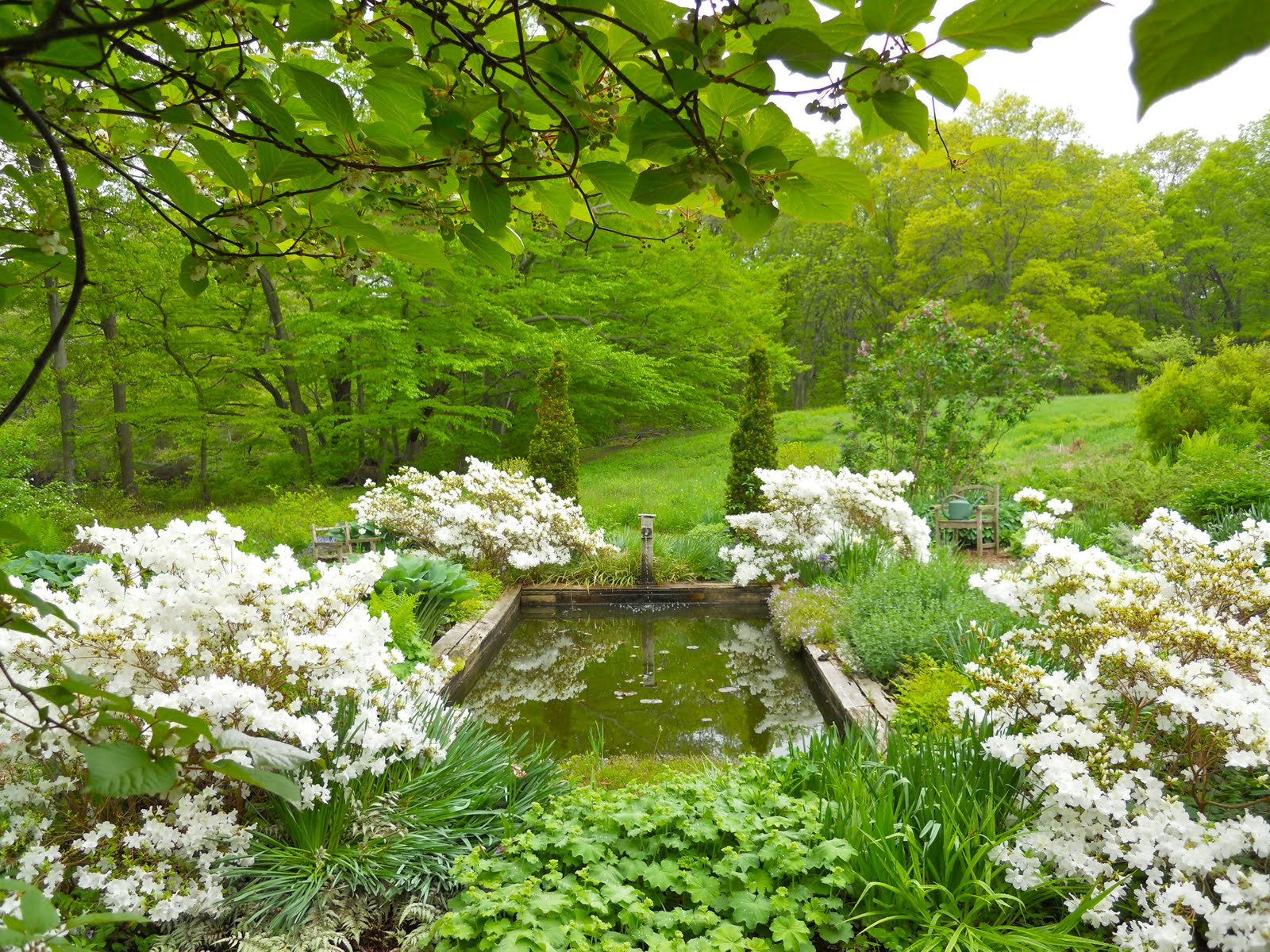
and the white azaleas are in putting on quite a show.
Ahhh Spring :-)
Monday, April 25, 2011
A Bit Daffy
With April's eponymous showers providing consistent moisture the gardens here in Seekonk seem to be growing overnight. It's been a particularly banner year for daffodils and the cool temperatures and gentle rain have kept the abundant blossoms from fading. For the past decade I've planted hundreds of new bulbs each fall and this year the resulting display has been exuberant to say the least.
In the front garden I've concentrated on primarily pink-cupped narcissus. Years ago the variety, Salome, was the premier cultivar in this new trend. Its flowers,however, were actually a yellowish-apricot. But more recent selections like Accent, which I planted in the bed bordering the lawn, produce flowers with trumpets that are more truly pink.
In the Hot Colored garden I've selected predominantly yellow and orange cultivars.
And of course in the Blue and White garden I've chosen exclusively white varieties.
That color scheme, however, has been compromised by a miss-labeled shipment of bulbs that I planted a few years ago. Uncharacteristically I haven't had the heart to rip them out yet.
Further muddying my palette are clusters of an old fashioned double yellow variety that randomly appear without regard for my strict artistic sensibilities. Most these end up in vases in my house.
In fact for the past month I've been cutting armloads of daffodils without putting much of dent in the outdoor display.
On rainy days It's a real luxury to have flowers from the garden on my kitchen table. It's a luxury, which I like to share. I gave the arrangement pictured below to a friend as a housewarming gift.
The only drawback to planting so many daffodils is the resulting mass of strap-like foliage, which must be allowed to ripen. Unfortunately, to ensure that the bulbs will flower next spring the leaves cannot be removed until they have turned brown. While I try to mask the dying vegetation with perennials, a brief but unsightly phase is almost unavoidable.
But then I guess every rose has its thorns.
Wednesday, March 23, 2011
Let The Games Begin.
The leaves are raked, the roses pruned and the beds freshly edged. The first blossoms of my crocuses are already summoning bees from their hives and the garden seems full of promise. Despite the the landscape's muted palette, the tans and browns possess a contemplative charm that is not without beauty. The lack of vegetation draws the eye to the emerging shoots and the diminutive spring flowers that herald the start of the season.
Emerging from the frozen earth the snowdrops
and the sight of the first hellebore blossoms are in some ways more exciting than June's prolific abundance.
It is at this time of year that the curves and angles of the landscape are most readily observed. Proportions, whether of beds, lawn or structures, impact a design's success and I am reminded that the new arches, which I installed last fall, are too tall and must be lowered before the growing season begins in earnest.
For the past several months the Northeast has been buried beneath record snowfalls. And while the branches of some woody ornamentals succumbed to its weight,the winter-long covering insulated my dormant perennials from frigid temperatures and bitter winds. While cleaning the beds I was relived to find that most everything seems to have weathered the cold. The only notable but unsurprising exception were the tea roses that I purchased from a box store last year. In expectation of their demise I ordered more from Edmund's roses in January and it seems that my cat, Briar, is impatiently awaiting their arrival.
With all my early chores completed ahead of schedule and the gardens looking neat and orderly I am ready for the games to begin. After all what is spring if not the most optimistic of seasons.
Subscribe to:
Posts (Atom)