Friday, June 25, 2010

Blue and White


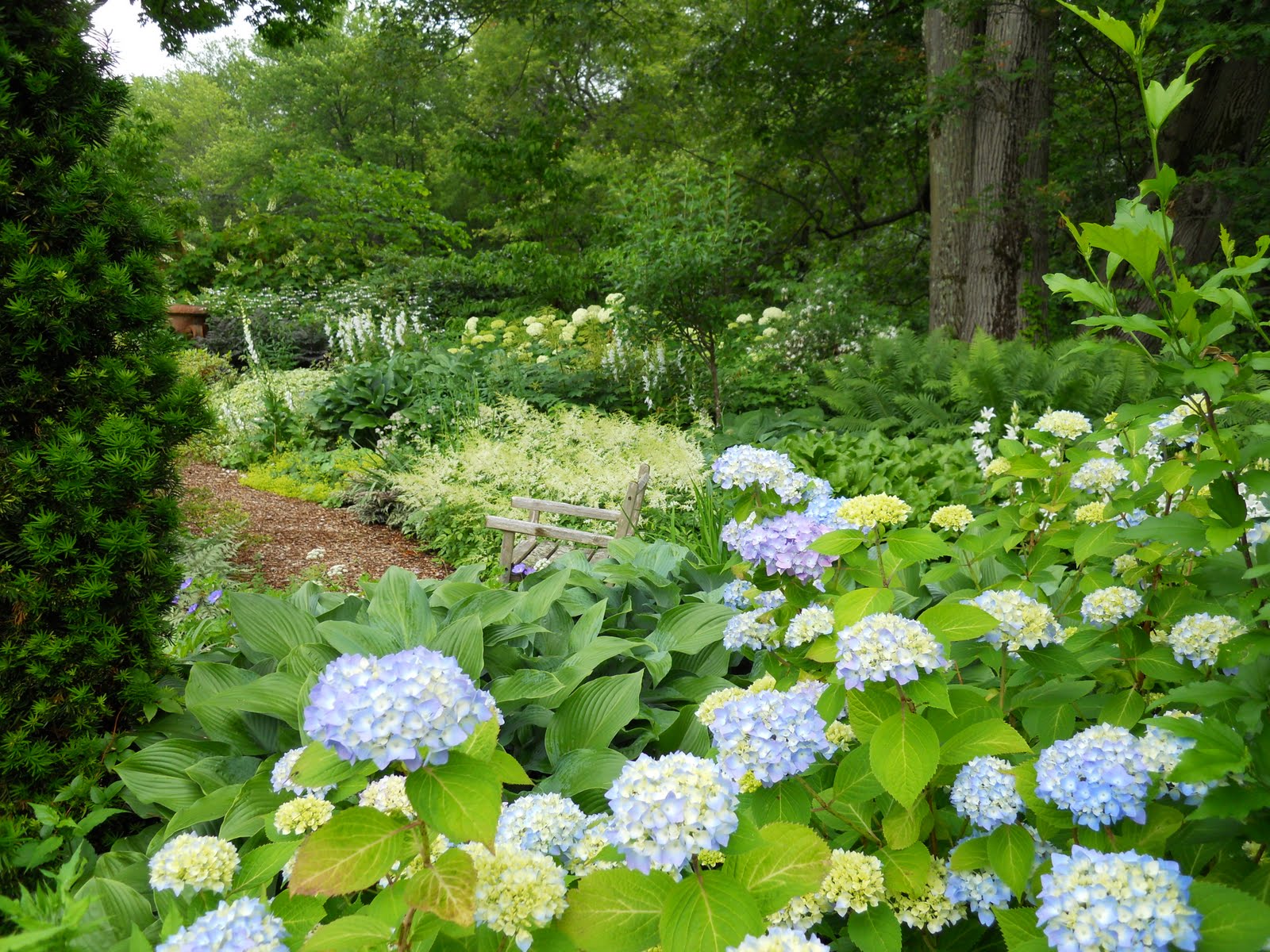
I find it hard to believe that almost twelve years have passed since I first installed the Blue & White garden at my home here in Seekonk. I can still remember the youthful exuberance with which I laboriously cleared brush with a pickax that first summer and the weight of the countless wheelbarrows I filled with debris. Now that I'm in my mid-forties I wouldn't consider undertaking such a back-breaking task. Having adopted the mantra that it's foolish to spend days on a chore that a machine can accomplish in a matter of hours, I'd hire a backhoe operator instead.


Although over the past decade my acre of land has evolved well beyond my original imaginings, in many ways the Blue & White garden remains my favorite part of the property. Partly this is because of its location near the field and river and partly it's because of the color scheme, which I still adore. Since the garden is set in what has become for all intents and purposes the back of the house, it is the last outdoor room that guests discover when visiting my home. At this time of year it remains barely visible until one reaches the edge of the checkerboard patio.


Even from the top of the stairs that lead down to the garden's mulched pathways the rectangular lily pond is concealed from view. Only the sound of splashing hints at the existence of a hidden water feature. Perhaps this slight element of surprise adds to its charm.


I've often wondered if it is the soothing color palette or the fact that the garden is set in the lowest part of my property that always seems to make the air feel cooler. If only I had the inclination to lounge on the bench beneath the arbor. Sadly, I find it difficult to relax in the garden. After a few minutes I invariably become distracted by a chore that requires my attention.


It's only when friends drop by that I take the time to simply enjoy the garden. For those brief moments I set my tools aside and try to view the garden uncritically as if seeing it through their eyes.


Maybe I should begin a new tradition and start making summer solstice resolutions. My first would be to spend more time savoring the fruits of my labors.


After all, in a few short months, the leaves will be turning and I'll be cutting the faded stems to the ground. So today I plan to pick up a book and go sit in garden and read. But first I have some snapdragons to plant and dahlias to stake.The roses need water and the daylilies are ready to be deadheaded and I really should mow the lawn again.....

Tuesday, June 1, 2010

War of the Roses


Earlier this spring I noticed that my rose bushes, many of which I've had for a number of years,were barely leafing out. I mentioned the problem to a gardening chum who promptly diagnosed the problem. "You probably have winter moths," she announced with an ominous lift of her brow. After doing a bit of online research I discovered that winter moths have recently appeared in New England and are currently munching their way across Massachusetts.


The prodigious damage isn't actually caused by the moths, but rather their inch worm-like caterpillars. These voracious pests are pale green and quite tiny, which explains how I originally failed to notice them. I tried wiping them out with neem oil, an organic pesticide, but my efforts barely slowed their destructive pace. Hoping that eventually the caterpillars would stop eating to spin their cocoons, I gambled that my rose bushes would probably recover once the attack subsided. I soon realized, however, that the caterpillars were eating not only my roses, but my crab apple trees and flowering plums as well.In fact they appeared to be eating just about everything. While I had resigned myself to a year without roses, I couldn't stomach the prospect of having my entire yard denuded.


A few years ago I waged a war against a groundhog that was rapidly mowing my garden to the ground. Each morning I'd discover another prized clump of phlox or some other glorious treasure reduced to a broken tangle of chewed stems. Over a period of weeks I exhausted every humane remedy I could think of; clumps of dog hair, moth balls, various foul smelling repellents, and a havahart trap, which succeeded in catching an opossom. I even hired a professional pest removal company to no avail. Finally, after searching online, I ordered some snares and caught the creature in less than twenty-four hours. I won't regale you with the gory details, but suffice it to say that my final showdown with the groundhog was not an experience I care to repeat.


Having faced down a marauding groundhog, I wasn't about to let caterpillars destroy my entire garden. Last month in an act of desperation I called my arborist and had him spray my property. The proximity of my two lily ponds and the adjacent river severely limited his choice of pesticides as many are lethal to fish and other aquatic creatures. I believe he settled on a horticultural oil, which is less toxic than other chemicals. Although I felt terribly guilty about calling in a chemical arsenal, his spraying did the trick. As you can see from my photographs the gardens rebounded nicely and the roses this year are more lovely than ever.

Saturday, May 8, 2010

In The Blink Of An Eye.


I find it rather bittersweet that many of my favorite spring time vignettes come and go with heart breaking speed. Perhaps that is why I look forward to their appearance in the garden with such anticipation and treasure them so dearly. Although my daffodils and tulips have been making a lovely display for a good two months now, the flowering of the four Delaware Valley White azaleas that anchor the corners of the lily pond in the Blue & White garden seems to pass in the blink of an eye.


I recently purchased a new camera and have been snapping photos every day in hopes of capturing the cloud of white flowers at their peak. This year the azalea blossoms briefly coincided with the opening of the crepe-like petals of my white tree peony, an equally fleeting and rare treat.


On the other side of my house the Clematis Montana Rubens that climbs across my roof is covered in vanilla scented pink flowers.


Although its flowering is brief in comparison with most other clematis varieties,Montana Rubens mounts an incomparable display. Unlike many of its cousins it isn't in the least bit fussy, tolerates full sun as well as part shade and rarely succumbs to the dreaded clematis wilt.


Perhaps more subtle, but in my opinion equally lovely is the unfurling of the red tinged leaves of the ornamental rhubarb, Rheum Palmatum var Tanguticum, that anchors the back side of the farm pond. While the leaves will retain some of their vibrant color for most of the summer, they are most striking in the spring.


I find them particularly lovely when combined with the bold chartreuse foliage of the dramatic hosta Sum and Substance.


In another week the azalea blossoms will litter the ground. I may pause to lament their passing before reminding myself that a successful landscape design doesn't rely on the bounty of a single plant. It is the overall composition; the interplay of physical structure and plant selection that truly make a garden beautiful. Or perhaps, I'll simply turn my attention to the peonies, roses, and bearded irises that are about to burst into bloom.

Monday, April 12, 2010

Daffodil Daze


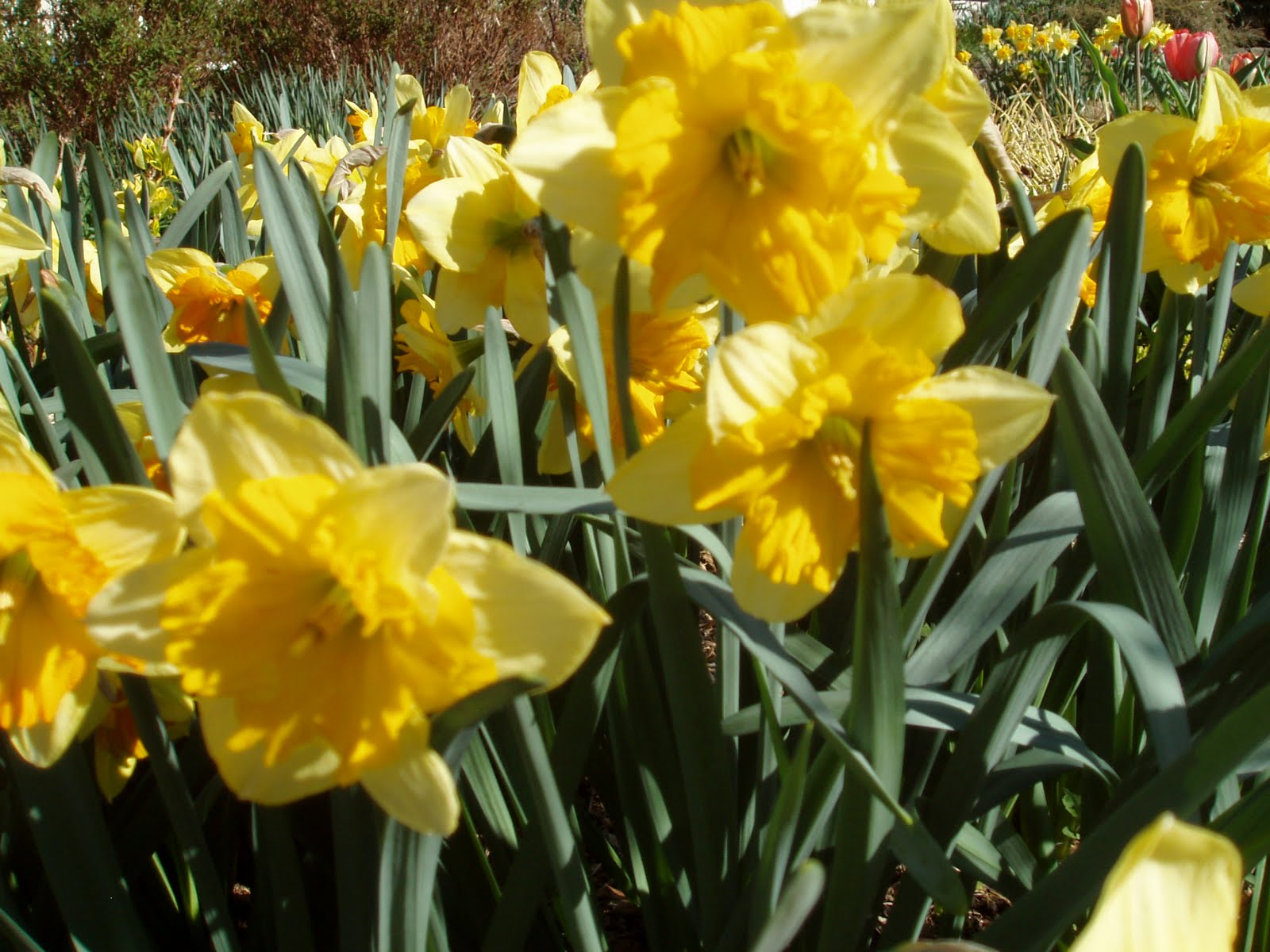
Of the multitude of spring flowering bulbs available today daffodils (narcissus) are undoubtedly my favorite. Although for sheer flamboyance some may prefer the tulip, tulip bulbs must be replaced every few years to ensure a bountiful display. When planted with a modicum of care in a sunny spot, however, daffodils become more floriferous over time.


While it's true that when compared to tulips the color palette of the genus narcissus is somewhat limited, encompassing combinations of yellow, white, orange and a range of peachy-pinks, the individual flowers exhibit a tremendous range of forms and unlike tulips are often endowed with a lovely fragrance. Below are just a few of the varieties blooming in my garden today.


Some people are fond of the diminutive varieties that must be viewed up close to truly appreciate their delicate blossoms. I prefer more robust plants that create greater impact in the landscape. Over the years I've planted them in the hundreds and this morning I counted well over a thousand blossoms in my garden.


Mid-April is is usually the height of the daffodil season here in Seekonk. Even so I'll continue to enjoy late-flowered varieties into the early weeks of May. I've found that with judicious selection it's possible to have daffodils in bloom for a good two months each spring.


There is a downside to planting such large quantities of daffodils. In order for the bulbs to store enough energy to increase in size and re-bloom, their foliage must be allowed to ripen, a process which can last until July. Cutting back the leaves too early will weaken the bulbs. Wherever possible I try to mask the unsightly clumps with perennials, but there invariably comes a time when I tire of looking at the withering leaves.


Nevertheless, as I was cutting flowers for a bouquet this morning, I found it hard to imagine my garden without its drifts of daffodil blossoms nodding in the spring breeze.

Tuesday, March 23, 2010

In Retrospect


A few months ago an editor at Gardens Illustrated, arguably the best gardening magazine published today, expressed interest in scheduling a photo shoot at my home in Seekonk. Via email he explained that he was searching for a suitable photographer and wondered if in the meantime I would send him a layout of the property. Since I'm a Landscape Designer, he obviously assumed that I had already drafted a plan of the gardens for my own use. The truth, however, is that my design process here has been improvisational, relying more on stakes,twine and unexpected inspiration than the drafting table.


When I set about drawing up a master plan of my property, I recalled how it had looked back in 1998 when I first moved in. At that time the rundown, yellow clapboard house had been surrounded by a maze of weedy paddocks, gravel driveways and dilapidated out buildings. In truth I'd originally been charmed by the beauty of the adjoining wildlife sanctuary with its river and woods not the land which I would come to own. And although I always intended to garden here, I never imagined the extent to which I would transform my single acre or the time, money and energy the process would consume.


Beginning with the Blue and White garden, which occupies what had formerly been a tangle of brambles and poison ivy bordered by a low rock wall, I eventually worked my way around the house removing and installing driveways (more than once), tearing down garages, taking out paddock fences and turning field to lawn. In my profession time for contemplation is an uncommon luxury and in hindsight it's obvious that each new garden influenced the character of subsequent features. As I finished my master plan I realized how much knowledge I had gained during the past decade and wondered what the property would look like today had I designed it in one fell swoop.


So what's next? Well to be honest, I'm not sure that I can handle more maintenance. After all, I have a job and it would be nice to have time for a bit of a social life. Still, lately I've been fantasizing about building a rockery in the slope near the river and I'd love a rustic summerhouse with a fireplace and a hammock somewhere behind the urn that marks the end of what will be a rose garden this year.


As for Gardens Illustrated, I'm still not certain that they're coming this summer, but if they do you'll be the first to know.

Saturday, February 27, 2010

Seed And Be Seen


California Poppy


Last year at about this time the urge to get my hands in the soil prompted me to start some seeds indoors,something I hadn't done since I was a kid. Back then I used a fancy three tiered grow light stand that I had received as a birthday present. Today a similar stand would cost several hundred dollars and with the recession looming I opted for a cheaper approach. At Lowes I purchased a pair of inexpensive, rectangular workshop light fixtures. After fitting them with tubular florescent lights, I hung them over a table in my basement.


Nicotiana Sylvestris


Once my lights were in place I ordered seeds from the Thompson & Morgan catalogue. I like their selection because they carry unusual varieties of common plants. In the past I've purchased unique zinnias, sunflowers and nasturtiums, all of which are best sown directly into the garden once the soil warms. For indoor propagation, however, I focused on plants that would benefit from an early start. I also chose varieties that wouldn't be available at the nurseries I frequent later in the season. I settled on a new variety of California Poppy (Eschschoizia Californica), Nicotiana Sylvestris, noted for its fragrant white flowers, and Cosmos Double Click, a new double form of the old garden favorite.


Cosmos Double Click


Eschewing the various deluxe seed-starting containers sold in speciality catalogues, I filled old six-inch pots with seed starting mix. After sowing my seeds, I covered the pots with plastic wrap held in place with rubber bands. The wrap creates an effect much like a mini-greenhouse. Once the seedlings sprouted, I thinned them out until only five seedlings remained in each pot. Even so, since I started with ten pots of each variety I ended up with more plants than I needed. Plants sown indoors require a period of hardening off, the process by which plants are slowly acclimated to the outdoor environment. As the weather began to warm I placed mine outside in a sheltered spot in the morning and returned them to the basement at sundown. After all danger of frost had past, I planted them in the garden and enjoyed their flowers for much of the summer.

So what am I going to start indoors this year? To be honest I've decided that, although the process was fun, the results didn't justify the cost or effort. While it's true that I might not be able to find the exact varieties on my wish list at a garden center this spring, the selection of summer-flowering annuals has improved tremendously in recent years. And besides, I enjoy touring nurseries and buying plants. Though the cost may be a bit higher than starting them myself, it's a simple pleasure that for me is guilt free...well almost.

Saturday, January 30, 2010

The White Witch


For many people winter is a period of withdrawal and introspection, but for gardeners it is perhaps the most optimistic time of the year. Once the holidays are passed and visions of sugarplums have faded from memory, imaginations fill with dreams of the perfect garden yet to come. Distracted by the glossy pages of seed catalogues and the imminent arrival of spring promised by the lengthening days, it can be all to easy to overlook February's snowy beauty. As I write this post, the squall swirling outside my window conjures images of C.S. Lewis' Narnia. To my eye the blanket of white dusting the landscape rivals any effect my efforts have yet achieved. Winter's muted palette of browns, greens and white has a sophistication that renders summer's jubilance almost juvenile by comparison.


In June my roses and peonies steal attention from the surrounding landscape. The river recedes mysteriously into the the distance and the trees become little more than a green backdrop. Now I see that this hierarchy is reversed. My gardens appear dwarfed by the breadth of the icy river and the depth of the adjoining woods. Surprisingly, I find that I hardly miss them at all.


Of course I know that soon enough I'll tire of the cold and long for the sight of some cheerful color. I can already hear myself cursing March for delivering so little in the way of warmth. For the moment, however, I'm content to let the perennials sleep while I contemplate winter's subtle beauty.