Tuesday, August 24, 2010

Dinner Is Served


At the risk of repeating myself I must profess that I am exceedingly fond of dahlias. In fact they are probably one of my all time favorite flowers. While my peonies are incomparably lovely, they bloom for but a few weeks and I have yet to discover an attractive way to keep their heavy flowers upright. Many of my roses offer fragrance as well as voluptuous beauty, but the bushes are plagued by a host of insects like Japanese beetles. Invariably by mid-August their leaves are disfigured by black spot and mildew. Dahlias, however, are relatively pest-free and bear blossoms in an almost limitless array of colors, shapes and sizes. Though they have very little scent, they more then compensate for their lack of fragrance by producing an abundance flowers at the tail end of the season when little else is in bloom.


In the past I've restricted my choice of dahlia varieties to those with relatively small flowers the modest size of which compliment the perennials and flowering shrubs in my gardens. This spring, however, I decided to plant a combination of tea roses and dinner plate dahlias in the parallel beds pictured above. Last summer I grew zinnias and Italian sunflowers in these beds and thought this new pairing would make a wonderful combination for cutting. I'd wanted to try my hand at tea roses for some time, but they're too fussy for my perennial borders and my gardens aren't large enough to accommodate the scale of the dinner plate dahlias.


Once the standard requirements of full sun, good soil and a little bone meal are fulfilled, the real trick to growing large flowered dahlias is figuring out how to stake them properly. The blossoms are so enormous (the pink one pictured above is almost a foot across) that their stems invariably snap if they aren't given a good deal of support. A couple years ago I discovered a very attractive solution to this problem literally in my own backyard.


Shortly after I purchased my property a crop of pesky Sumac seedlings appeared in the field behind my house. Sumac is a tenacious, fast growing weed tree and despite persistent springtime mowings the saplings continued to sent up new shoots.


To my dismay each year this new growth has gotten taller and now the towering stems must be cut by hand. A few autumns ago, while sawing down the current crop it occurred to me that the the long straight saplings would make wonderful heavy duty garden stakes. Not only are they more attractive than those available at garden centers, but they have proved to be the perfect sturdy supports for many plants, including my dinner plate dahlias.


In early May I arranged three Sumac stakes in a tight triangle and planted a single dahlia tuber in its center. Over the course of the summer I've looped twine around the stakes making a tight cage that has successfully held the dahlia's heavy stems in place. As it turns out the stakes are really only good for one season, but out in the field there's already a fresh crop of ten foot tall saplings ready to be harvested.


As for the tea roses, I made the mistake of buying cheap bare root plants from a discount store. Of the twenty I purchased only about half took hold. Still I've been encouraged by the fact that many of the survivors have thrived. Next year I'll shop with an eye to quality not cost and focus on fragrance. After all there's nothing like coming home to the sweet smell of roses.

Sunday, August 8, 2010

August Field Trip


Some of my readers may recall that last October I posted an essay entitled "Rock The Slope". Included were pictures of a rock garden that I had recently installed for clients who own a large parcel of land that straddles the Connecticut/Rhode Island border. The property, of which I'm quite envious, includes a mill pond with a rushing brook and waterfall, a few out buildings and an historic Barrel Mill that my clients converted into a charming residence. Last year I promised to share some photos of the other projects which I have completed on the property and thought the dog days of August might be an opportune time to take a virtual field trip.


During our initial consultation more than five years ago, my clients asked me to include a swimming pool in their master plan. I'm a firm believer that in the Northeast whenever possible pools should be hidden from view. After all for almost eight months of the year a swimming pool is little more than a cement hole covered with a tarp. After analyzing various options I placed a pool garden parallel to the foundation of their existing barn. The siting of the pool seemed a logical choice and brought a sense of order to the randomness of their property. I enclosed the entire garden, which contains an arbor, patios and a twenty by sixty foot rectangular pool, with a black chain link fence hidden by privet hedges.


My clients already owned a dramatic pair of wrought iron gates, which made a wonderful addition to the garden.To further integrate the barn into the new design, I centered a parterre on its facade.


The parterre serves as an entrance to the pool garden and connects it with a flower-filled rock garden that leads back up to the main house.


The parterre is laid out in a simple geometric design and its beds are planted with boxwoods, low maintenance roses and perennials punctuated by tree-form lilacs and hydrangeas. The centerpiece of the parterre is a fountain that I fashioned out of a mill wheel, one of a number that my clients found on the property. The granite wheel sits on a sunken fiberglass basin filled with the same peastone used on the pathways. Water spilling over the fountain's sides seems to magically disappear into the gravel walkway.


As for the rock garden on the far side of the house, it is filling in nicely. I think that its palette, a subdued combination of greens and whites, subtly compliments the adjoining pond and woods.


Monday, July 12, 2010

Cottage Industry


The other day a client who visited my gardens here in Seekonk remarked that my house was like an English cottage. While I don't technically live in a cottage, I think the facade of my house is well suited to the landscape style commonly referred to as a cottage garden. In truth though, the plantings surrounding my home have a bit more structure than is typically associated with the more haphazard cottage look. Over the past few years, however, I have let certain plants self-seed and the result has softened the garden's original design. For the most part these serendipitous additions have enriched the overall effect. I admit, however, that it's a fine line that I'm walking. Recently I've begun to question at what point lush becomes simply overgrown. Although it may be difficult to tear healthy plants from the ground for the sake of aesthetics, heavy handed restraint is required when a good thing becomes too much of a good thing.


Adhering to a designated color scheme is essential to keeping some semblance of order and intention in the garden. Along the back side of my house the hot colored garden is currently dominated by a stand of lilies the flowers of which were supposed to be yellow with darker rust stripes. Unfortunately as their blossoms mature the petals fade to a color that reads as white. This year I also purchased a batch of copper-colored yarrow. Unfortunately like the lilies its flowers take on whitish tones as they age.


To my eye the white flowers mar the integrity of the garden's design. While there is something appealing about abundance, without the structure of a rigid color scheme the planting looks simply cluttered. I've been tempted to cut the lilies and stuff them in a vase but haven't quite summoned up the nerve. This fall I'll dig up their bulbs and move them to the front of the house where their creamy petals will work to greater advantage. Since I haven't decided how to successfully use a plant with orange flowers that after quickly fading remain white for weeks on end, I may have to consign the yarrow to the compost pile.


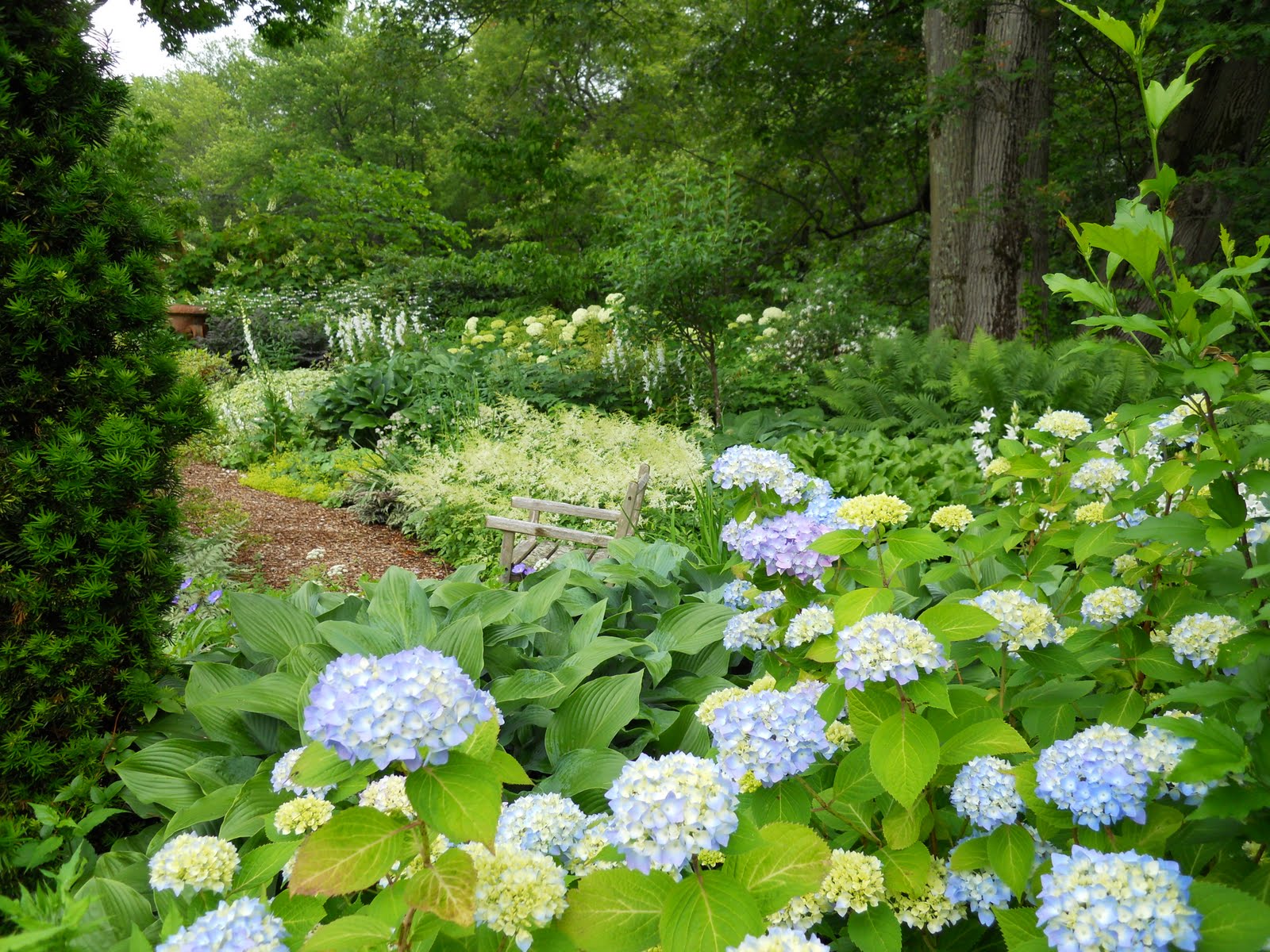
Lately I've been wondering if much of anything is still going to be flowering in my garden come September. Spring in the Northeast arrived a good month ahead of schedule. With the exception of a nail-biting dip in the thermometer in mid-May that had me running my sprinklers throughout the night to ward off the frost, the weather has remained warm. In fact the last few weeks have been downright hot. 2010's precocious growing season is playing havoc with the sequence of bloom that I have meticulously choreographed. This year my lilacs flowered in April and my peonies peaked in May a good three weeks ahead of schedule. Many of the plants that I rely on for color in the late summer and early fall are already in bloom. Even my Autumn flowering anemones are in bud. Of course it's disappointing that once again my best laid plans have been foiled by Mother Nature. My frustration, however, was somewhat eased when this lovely vignette unexpectedly appeared in my Blue & White Garden.


In the past my Oakleaf and Lacecap hydrangeas haven't bloomed at the same time as the low-growing hosta. If the Clematis Heracleifolia that twines around the urn had opened its sky blue bell-shaped flowers ahead of schedule the composition would have been perfect.

Friday, June 25, 2010

Blue and White


I find it hard to believe that almost twelve years have passed since I first installed the Blue & White garden at my home here in Seekonk. I can still remember the youthful exuberance with which I laboriously cleared brush with a pickax that first summer and the weight of the countless wheelbarrows I filled with debris. Now that I'm in my mid-forties I wouldn't consider undertaking such a back-breaking task. Having adopted the mantra that it's foolish to spend days on a chore that a machine can accomplish in a matter of hours, I'd hire a backhoe operator instead.


Although over the past decade my acre of land has evolved well beyond my original imaginings, in many ways the Blue & White garden remains my favorite part of the property. Partly this is because of its location near the field and river and partly it's because of the color scheme, which I still adore. Since the garden is set in what has become for all intents and purposes the back of the house, it is the last outdoor room that guests discover when visiting my home. At this time of year it remains barely visible until one reaches the edge of the checkerboard patio.


Even from the top of the stairs that lead down to the garden's mulched pathways the rectangular lily pond is concealed from view. Only the sound of splashing hints at the existence of a hidden water feature. Perhaps this slight element of surprise adds to its charm.


I've often wondered if it is the soothing color palette or the fact that the garden is set in the lowest part of my property that always seems to make the air feel cooler. If only I had the inclination to lounge on the bench beneath the arbor. Sadly, I find it difficult to relax in the garden. After a few minutes I invariably become distracted by a chore that requires my attention.


It's only when friends drop by that I take the time to simply enjoy the garden. For those brief moments I set my tools aside and try to view the garden uncritically as if seeing it through their eyes.


Maybe I should begin a new tradition and start making summer solstice resolutions. My first would be to spend more time savoring the fruits of my labors.


After all, in a few short months, the leaves will be turning and I'll be cutting the faded stems to the ground. So today I plan to pick up a book and go sit in garden and read. But first I have some snapdragons to plant and dahlias to stake.The roses need water and the daylilies are ready to be deadheaded and I really should mow the lawn again.....

Tuesday, June 1, 2010

War of the Roses


Earlier this spring I noticed that my rose bushes, many of which I've had for a number of years,were barely leafing out. I mentioned the problem to a gardening chum who promptly diagnosed the problem. "You probably have winter moths," she announced with an ominous lift of her brow. After doing a bit of online research I discovered that winter moths have recently appeared in New England and are currently munching their way across Massachusetts.


The prodigious damage isn't actually caused by the moths, but rather their inch worm-like caterpillars. These voracious pests are pale green and quite tiny, which explains how I originally failed to notice them. I tried wiping them out with neem oil, an organic pesticide, but my efforts barely slowed their destructive pace. Hoping that eventually the caterpillars would stop eating to spin their cocoons, I gambled that my rose bushes would probably recover once the attack subsided. I soon realized, however, that the caterpillars were eating not only my roses, but my crab apple trees and flowering plums as well.In fact they appeared to be eating just about everything. While I had resigned myself to a year without roses, I couldn't stomach the prospect of having my entire yard denuded.


A few years ago I waged a war against a groundhog that was rapidly mowing my garden to the ground. Each morning I'd discover another prized clump of phlox or some other glorious treasure reduced to a broken tangle of chewed stems. Over a period of weeks I exhausted every humane remedy I could think of; clumps of dog hair, moth balls, various foul smelling repellents, and a havahart trap, which succeeded in catching an opossom. I even hired a professional pest removal company to no avail. Finally, after searching online, I ordered some snares and caught the creature in less than twenty-four hours. I won't regale you with the gory details, but suffice it to say that my final showdown with the groundhog was not an experience I care to repeat.


Having faced down a marauding groundhog, I wasn't about to let caterpillars destroy my entire garden. Last month in an act of desperation I called my arborist and had him spray my property. The proximity of my two lily ponds and the adjacent river severely limited his choice of pesticides as many are lethal to fish and other aquatic creatures. I believe he settled on a horticultural oil, which is less toxic than other chemicals. Although I felt terribly guilty about calling in a chemical arsenal, his spraying did the trick. As you can see from my photographs the gardens rebounded nicely and the roses this year are more lovely than ever.

Saturday, May 8, 2010

In The Blink Of An Eye.


I find it rather bittersweet that many of my favorite spring time vignettes come and go with heart breaking speed. Perhaps that is why I look forward to their appearance in the garden with such anticipation and treasure them so dearly. Although my daffodils and tulips have been making a lovely display for a good two months now, the flowering of the four Delaware Valley White azaleas that anchor the corners of the lily pond in the Blue & White garden seems to pass in the blink of an eye.


I recently purchased a new camera and have been snapping photos every day in hopes of capturing the cloud of white flowers at their peak. This year the azalea blossoms briefly coincided with the opening of the crepe-like petals of my white tree peony, an equally fleeting and rare treat.


On the other side of my house the Clematis Montana Rubens that climbs across my roof is covered in vanilla scented pink flowers.


Although its flowering is brief in comparison with most other clematis varieties,Montana Rubens mounts an incomparable display. Unlike many of its cousins it isn't in the least bit fussy, tolerates full sun as well as part shade and rarely succumbs to the dreaded clematis wilt.


Perhaps more subtle, but in my opinion equally lovely is the unfurling of the red tinged leaves of the ornamental rhubarb, Rheum Palmatum var Tanguticum, that anchors the back side of the farm pond. While the leaves will retain some of their vibrant color for most of the summer, they are most striking in the spring.


I find them particularly lovely when combined with the bold chartreuse foliage of the dramatic hosta Sum and Substance.


In another week the azalea blossoms will litter the ground. I may pause to lament their passing before reminding myself that a successful landscape design doesn't rely on the bounty of a single plant. It is the overall composition; the interplay of physical structure and plant selection that truly make a garden beautiful. Or perhaps, I'll simply turn my attention to the peonies, roses, and bearded irises that are about to burst into bloom.

Monday, April 12, 2010

Daffodil Daze


Of the multitude of spring flowering bulbs available today daffodils (narcissus) are undoubtedly my favorite. Although for sheer flamboyance some may prefer the tulip, tulip bulbs must be replaced every few years to ensure a bountiful display. When planted with a modicum of care in a sunny spot, however, daffodils become more floriferous over time.


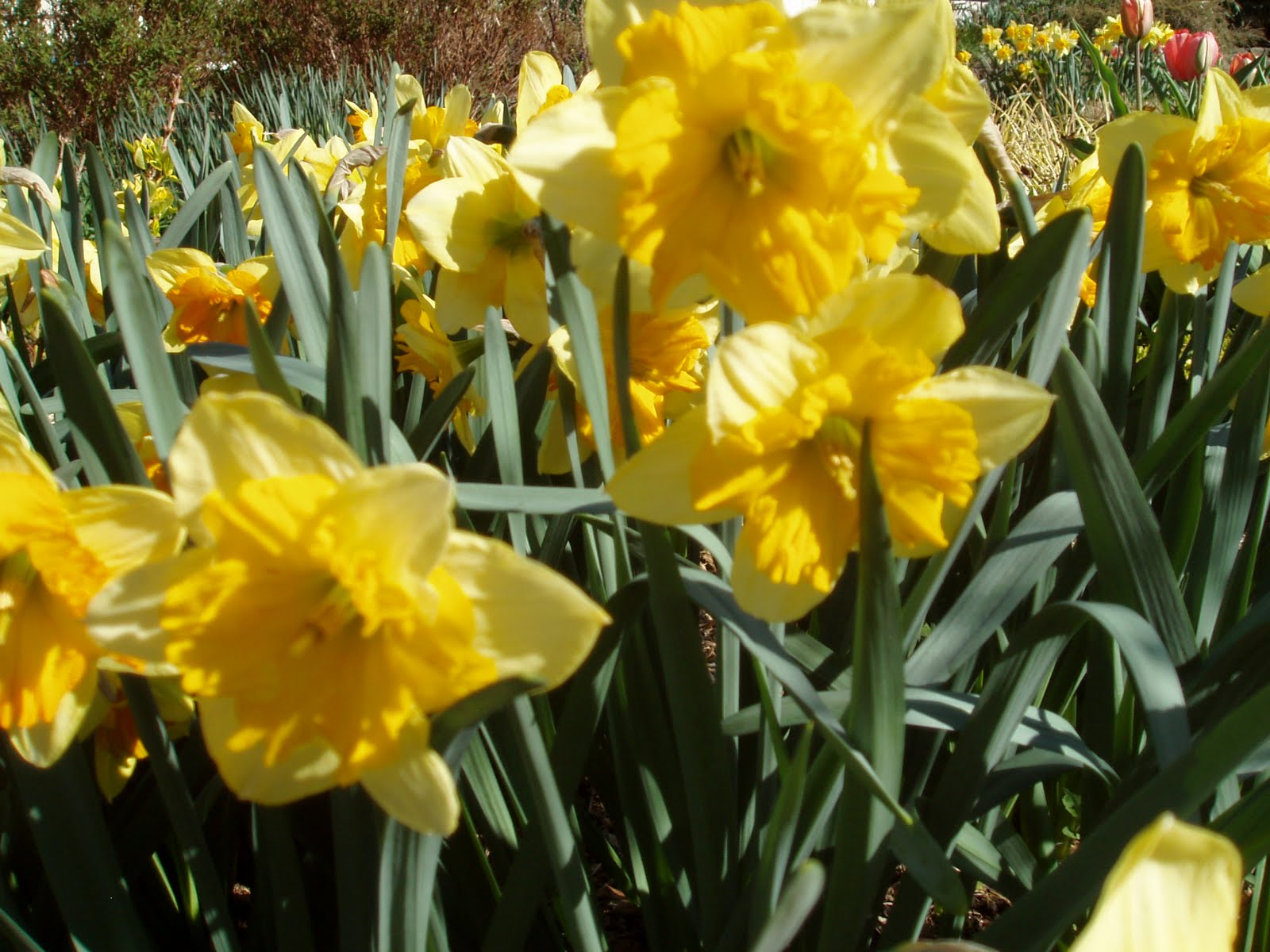
While it's true that when compared to tulips the color palette of the genus narcissus is somewhat limited, encompassing combinations of yellow, white, orange and a range of peachy-pinks, the individual flowers exhibit a tremendous range of forms and unlike tulips are often endowed with a lovely fragrance. Below are just a few of the varieties blooming in my garden today.


Some people are fond of the diminutive varieties that must be viewed up close to truly appreciate their delicate blossoms. I prefer more robust plants that create greater impact in the landscape. Over the years I've planted them in the hundreds and this morning I counted well over a thousand blossoms in my garden.


Mid-April is is usually the height of the daffodil season here in Seekonk. Even so I'll continue to enjoy late-flowered varieties into the early weeks of May. I've found that with judicious selection it's possible to have daffodils in bloom for a good two months each spring.


There is a downside to planting such large quantities of daffodils. In order for the bulbs to store enough energy to increase in size and re-bloom, their foliage must be allowed to ripen, a process which can last until July. Cutting back the leaves too early will weaken the bulbs. Wherever possible I try to mask the unsightly clumps with perennials, but there invariably comes a time when I tire of looking at the withering leaves.


Nevertheless, as I was cutting flowers for a bouquet this morning, I found it hard to imagine my garden without its drifts of daffodil blossoms nodding in the spring breeze.