Thursday, May 9, 2013

Monet Moment


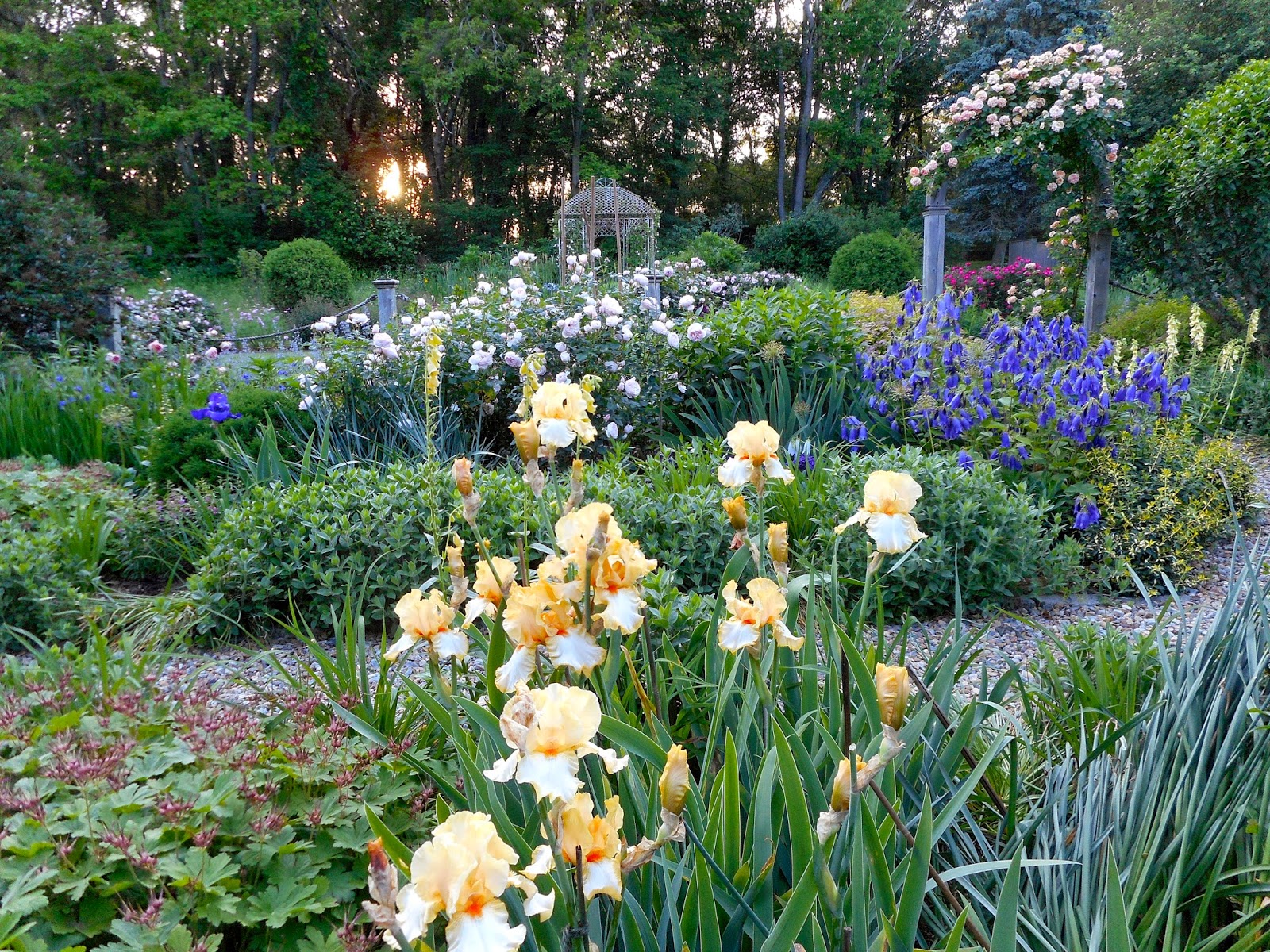
It should come as no surprise that I've been greatly influenced by a visit I made some years ago to Monet's famous gardens. Giverny's iconic wisteria covered bridge inspired the pair of wisterias that flank my farm pond. I dug the plants up in the woods behind my house where they were languishing in the shade and have been training them as small trees or "standards". When grown in this manner their rampant twining habit is more manageable and they're quite easy to maintain. Last spring a late frost damaged their blossoms. This year, however, they are literally dripping with flowers and I'm quite pleased with the effect


The upright, dark blue flowers of Camassia Coerulea, a moisture loving hardy bulb, complement the wisterias drooping racemes. Camassias come in shades of blue and white and range in height from fifteen to thirty inches. I find them pest free and nearly indestructible. They bloom with the last of the tulips and daffodils, which makes them a great addition to the late-spring garden.

 
During a recent spate of consulting work, I've visited a number of properties plagued by the same problem, too much variety. This common mistake invariably creates an unsatisfactory, visual jumble. It bears repeating that when it comes to landscape design, bold groups of a single species are preferable to a hodgepodge a different plants. While I realize that it can be hard to edit one's desires, restraint and repetition are the keys to a successful landscape.


Unless I want to frame a view, as with the Arborvitae balls and Wisterias pictured above, I almost never plant just two of something and a single specimen is best used as an accent or focal point. The misuse of pairs or singles invariably creates visual clutter. The same might be said of rows. Whether tall or short, straight or curved, rows of plants act like a frame,separating areas within the landscape.Unless they serve a purpose such as framing a walkway or a particular garden area, random stripes are best avoided.


We're finally getting some much needed rain here in Seekonk. The precipitation is quite a relief as I've been running my irrigation for the past two weeks and a dry, dusty spring doesn't bode well for the garden. On a celebratory note this is my 50th post, a milestone on sorts, and I want to thank my readers for their comments and support!
      

Tuesday, March 19, 2013

CUTTING EDGE


It's currently snowing here in Seekonk, but despite the spate of un-springlike temperatures I've been hard at work for the past few weeks pruning shrubs, cleaning out debris and re-edging my beds. Although it's a bit of a chore,nothing makes a garden look better at the start of the season than beds with nice crisp edges. Whether curved or straight, however, I find it nearly impossible to create a clean edge by simply eyeballing the beds, so instead I use a length of rope.


Some years ago I purchased a large spool of three-ply rope at a box store. For ease of movement and tangle-free storage I transferred the rope to a hose reel. The rope I selected has a bit of weight to it and is better for shaping new beds than a length of hose. I find it the perfect tool for creating both straight lines and sinuous curves.  


For a straight line I anchor the rope to the ground by pushing the point of a large flathead screwdriver through one end. I then pull the rope taut and anchor the far end in the same manner. It often takes a few tries to get the rope perfectly straight or in case of curves to achieve the desired shape.


Once the rope is secured, I use a can of paint and spray a wide band directly over the top of the rope, making sure that the paint spreads to each side of the rope.

  
Any cheap paint will do. I like white, but after a few weeks or a mowing the paint disappears so color isn't that important. Dusting the top of the rope with powdered lyme also works and quickly vanishes. However, I find paint more convenient and easier to handle. 


After waiting a moment or two I flick the rope away. The resulting parallel bands of white provide the perfect guide for my edger.


Inserting the blade between the white lines I work my way easily down the bed.


The result is a crisp, straight edge that makes the beds look clean and sharp.

after edging

The result is a vast improvement.

before edging

If it ever stops snowing, the crisp edges will create the perfect frame for flower-filled beds.


On a completely unrelated matter, I'm excited to announce that I've recently redesigned my website, andrewgrossman.com. There are more pictures and visitors can watch my cable series, IN THE GARDEN, simply by logging onto the site. I hope you're as pleased with the improvements as I am.

Thursday, December 27, 2012

YEAR END FAVORITES


Some of my readers may recall that last winter I shared a few of my favorite garden plants in a post entitled "Top Ten". Continuing the tradition, I'm including another group of indispensable selections. They may not be the most exotic subjects, but they have all proven their mettle. This year's list includes perennials, shrubs and vines all of which I have used both in my garden and in designs for my clients. Without exception they have performed superbly with a minimum of care.
 
1) Deutzia Nikko

This small, spring blooming bush covers itself with pure white flowers in late May or early June. I often use it in in large groups or as an edging plant in full sun. It also mixes quite well with perennials. There is a larger version as well, but I prefer this petite selection.

2) Clematis Montana Rubens

Although I'm embarrassed to admit that I haven't had much luck with large-flowered clematis, Montana Rubens never disappoints. Here I'm growing it over my roof, where its pink blooms put on a wonderful display that compliments the last of the daffodils. This is a sturdy vine that requires some space in either part shade or full sun. At my mother's house it covers a large arbor beneath a old, sugar maple, which is a testament to it's tenacity. The new foliage and stems have a lovely reddish caste and the flowers smell faintly of vanilla.

3) Echinacea Hot Papaya


Not that long ago Echinaceas came only in pink or white single flowers like large daisies. Recently,however, new colors and flower forms have become available. I've tried a number of these introductions only to be disappointed by their performance and longevity. Hot Papaya is an exception. If planted in full sun the plants bloom for months. I use this variety in my hot colored garden where its bright reddish-orange flowers make a dramatic display that is anything but demure. Unfortunately groundhogs find the flowers as irresistible as I do.     

4) Digitalis Ambigua


Most foxgloves are biennials that form a roseate of leaves their first year and flower spikes the second. After blooming the plants set seed and die. The yellow flowered Digitalis Ambigua is a relatively long-lived exception. In full sun or part shade the plants, which have few pests and are ignored by deer, flower heavily in early summer and often bloom repeatedly until frost. They are also prolific self-seeders, increasing their numbers at a bountiful rate. They make a wonderful addition to the perennial garden or more naturalized plantings like the one pictured below, which I created for a client a few years ago. 


5) Hydrangea Coerulea Lace


Many wonderful new hydrangea varieties have appeared in recent years but this old-fashioned beauty is still one of my favorites. It blooms abundantly in full to part shade and makes a terrific companion for ferns, hostas and astilbes. Unlike other hydrangeas it never fails to bloom and the flower color isn't affected by soil acidity. In the picture below I've paired it with Hydrangea Quercifolia (another old-time favorite) and hostas in my Blue and White garden. 


6) Ligularia The Rocket


Ligularias form a wonderful group of shade loving plants and at almost four feet tall, The Rocket, makes a bold statement in the garden. Without ample moisture the leaves wilt when struck by the sun, but soon recover when shade is reestablished.

7) Hosta Sum and Substance


The large, crinkled, chartreuse leaves pictured above belong to Hosta Sum and Substance. While there are countless wonderful hosta varieties available today, this variety remains one of my favorites. Over time it takes on almost shrub-like proportions and the foliage becomes increasingly textured as the plants mature. Tall stems sporting blue flowers crown the plants in late summer, but this variety is grown primarily for its dramatic leaves, which are impervious to snails and slugs. As shown here, If given ample moisture this hosta will tolerate full sun, but it prefers a sheltered position and makes a superb addition to the shade garden.

8) Cornus Ivory Halo


A smaller version of the more common variegated red twig dogwood, Ivory Halo makes a nice compact addition to the shrub border. Its leaves retain their silver edging all summer and in winter its brilliant red stems make a bold statement against the snow. It seems equally happy in sun or part shade and thrives in damp soil. As pictured below I have used it to great effect en masse in wetland gardens, where it flourishes even when subjected to periodic flooding.


9) Clematis Maximowicziana (Sweet Autumn Clematis)


The mass of small white flowers completely covering the arbor above belong to the Sweet Autumn Clematis. This somewhat rampant vine is a late-season workhorse and though its flowering is brief, the blossoms come at time when little else is in bloom. Equally at home in sun or part shade it will scramble over walls, along fences, up trees or across a pergola. Some pruning might be required to keep it in bounds, but the wealth of fragrant flowers is well worth the effort. 

10) Rosa Peach Drift


The Drift series of roses form a relatively new addition to the landscape rose category. In addition to peach they come in pale pink, white and red. They are virtually trouble free and at barely two feet tall and wide can be planted in small spaces where larger rose bushes would be problematic. Because they bloom from early summer until frost and are incredibly sturdy they have quickly become one of my favorite landscape roses. Planted en masse they make an unbeatable addition to the garden or shrub border. 

Well there you have it, ten more of my favorites, both new and old. Perhaps you'll find a home for one or more in your garden this spring.

Happy New Year!     

Wednesday, September 19, 2012

Home Grown


2012 has certainly been a banner year for dahlias. From the enormous blooms pictured above to the smaller blossoms that give my late summer gardens a much needed boost of color, my dahlias have never been more prolific. I'm not certain what confluence of events has produced such an abundance of flowers. Perhaps it can be attributed to the summer's heat and humidity combined with periods of dryness followed by heavy rain. Whatever the reason, I'm enjoying the bounty. For weeks now my house has been filled with bouquets.


As many of my readers may know, Dahlias are one of my favorite annuals. The tubers that produce these sumptuous flowers are inexpensive and require minimal care. Full sun, good soil, adequate moisture and sturdy stakes for the taller varieties are all that is needed to ensure success. Although marauding snails may nibble on young shoots and leaves, they don't seem to cause any permanent damage. This of course is an added bonus in my garden.


Like tulips, the number of dahlia varieties available on-line through reputable growers is almost infinite. As one may well imagine, the countless choices are both a blessing and curse.This spring, after deciding that it was easier to buy tomatoes and basil, I converted my small vegetable garden into a dahlia bed. The dahlias I planted there have grown so tall that I need a step ladder to cut the flowers. For every dahlia I plant in the spring I'm rewarded with as many as ten additional tubers in the fall. Since I dig and store my dahlia's in a cool dry place each winter, I've literally run out of space to plant them all. Not that I'm complaining, these are problems that a gardener can only wish for.


Some of you may have noticed that I generally photograph my farm pond from the uphill side with a view toward my house.


This is because the view from the opposite direction isn't nearly as satisfactory. Recently, however, I purchased a gazebo that rectifies this situation.


It's made out of steel and although it looks old, it is actually not an antique. I believe it was made in China and I'll be forever grateful to the dear friend that spotted it at a local dealer. I'd been looking for just such a structure for sometime and think it suits this spot perfectly. Now all I need is some comfortable seating. The current bench is terribly uncomfortable. In fact my friends are fond of remarking that none of my outdoor furniture is conducive to relaxation. They're right, but then I never relax in the garden. There's simply too much work to do.


Thursday, August 9, 2012

Back To Front


Some of my readers may recall that a year ago I received a commission from an English couple that had recently relocated to Scituate, MA via the Middle East. Their new property included a seasonally marshy area and a water feature that had fallen into disrepair.


During our initial consultation my clients expressed interest in replacing the broken pump system that had previously produced a waterfall. In addition I suggested that we redesign a large area of lawn, brambles and weeds surrounding the pond. Sharing their countrymen's famed fondness for gardens, they readily agreed.


It has been a little more than a year since we embarked on the transformation and the new plantings are flourishing.


For this large new garden area I selected plant material that can tolerate consistently damp to marshy conditions as well as periods of dryness. Due to one or two miscalculations involving seasonal moisture some of the plants had to be rearranged following the initial planting and my clients subsequently revamped a drainage system to accommodate the heavy downpours that often flooded the low-lying areas. For the most part, however, the plants have settled in quite nicely.


Beginning with Japanese Irises in the spring, the garden is in bloom until frost and the red stems of Cornus Ivory Halo along with the berries of Ilex Verticillata provide winter color.

Ilex Verticillata
Cornus Ivory Halo
Additional plantings include hydrangeas, clethra, swamp azalea, viburnums and a host of perennials such as astilbes, hostas, foxgloves, grasses, daylilies, physostegia and chelone.


I installed the various species in large drifts to give the final composition a naturalistic appearance that complements the pond and a dramatic twenty-foot waterfall. One might assume that having completed such an extensive project, my clients would take a moment to  rest on their laurels. This summer, however, they decided to revamp the front of their house as well.


My clients had their hearts set on a flower-filled front yard reminiscent of a classic English garden, a choice that I thought perfect for their lovely Tudor home. My first challenge, however, involved coaxing them to remove the narrow strip of lawn that bisected the front yard.

 
To keep the overall maintenance to a minimum I suggested that we choose primarily flowering shrubs and roses rather than more labor intensive perennials. I also swapped out the rectangular bluestone steppers and installed a path of rustic, irregular field stone.


For a touch of formality I lined the front walkway with Ilex Crenata ( a boxwood look alike) underplanted with silvery lambs ears, which should fill in nicely over time.


Although newly installed and recently battered by torrential rain when these photographs were taken, I'm looking forward to seeing the plantings mature. In a year or two I'm confident that the soil will no longer be visible. Instead the front walk will be awash in dark green, silver, pink and white.


On the home front, my gardens here in Seekonk are muddling through the dog days of summer and I have embarked on a new project. I am currently hosting a television show for a local cable station. The series entitled "In The Garden" is taped at my home and currently airs in southern MA. If you live outside of my area and would like to watch an episode or two google Seekonk Channel 9 and select schedule. You should be directed to the station's website. Select ON DEMAND and type in "In The Garden". You will be able to watch current and future episodes on your computer.


So far I have shot four episodes and plan on filming at least two more before the end of the season. It's a fun and challenging endeavor and I welcome your comments and feedback. Who knows, perhaps my series will be picked up by a larger network.


In the meantime, I'm honing the skills I cultivated in my twenties while pursuing a career as a dancer/performer in New York City. I guess that like the seasons, things have a way of coming around again.